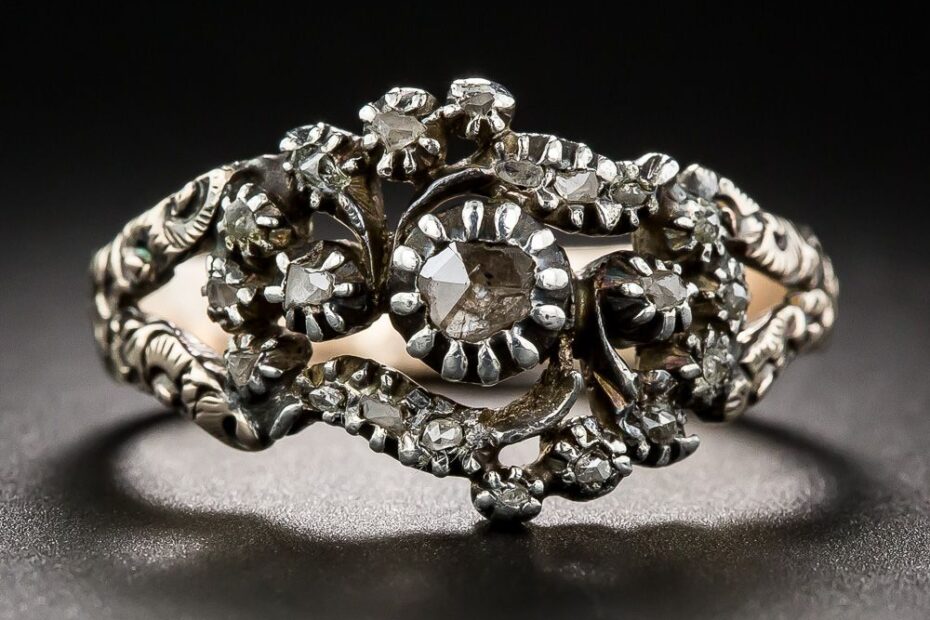
The history of personal adornment underwent a profound transformation during the period spanning roughly 1714 to 1830. Known as the Georgian era: named for the successive reigns of Kings George I, II, III, and IV: this century of craftsmanship established the very foundations of what we now classify as antique jewelry. To understand the intricacies of Georgian era jewelry is to appreciate a time when every single component, from the smelting of the gold to the hand-faceting of the stones, was the result of manual labor and artisanal intuition.
In an age predating the industrial revolution’s impact on the decorative arts, jewelry was not merely an accessory but a testament to the technical limitations and creative triumphs of the 18th and early 19th centuries. Collectors today prize these pieces for their rarity and the "soft" aesthetic that modern mass production simply cannot replicate.
The Hand-Forged Nature of Georgian Craftsmanship
The defining characteristic of Georgian era jewelry is its strictly manual construction. Because steam-powered machinery and die-striking techniques were not yet ubiquitous, every piece was hand-forged. A jeweler of the 1700s began with raw ingots of gold or silver, which were hammered into thin sheets or drawn into fine wires.
This lack of mechanization means that authentic Georgian pieces possess a certain organic irregularity. If you examine a Georgian ring or brooch under magnification, you will often find slight asymmetries in the settings and tool marks left by the artisan’s files. These are not flaws; rather, they are the fingerprints of history. This manual intensity limited production, ensuring that jewelry remained an exclusive luxury for the aristocracy and the rising merchant class. Because gold was scarce and expensive, many pieces from this era were eventually melted down to create newer styles in the Victorian period, making surviving Georgian examples exceptionally rare.
Silver-Topped Gold: A Technical Necessity
One of the most fascinating technical hallmarks of this era is the "silver-topped gold" (or silver-over-gold) construction. During the Georgian period, platinum was not yet used in jewelry making, as the technology required to reach its high melting point did not exist. However, jewelers understood a fundamental principle of aesthetics: diamonds set in yellow gold often take on a yellowish tint, diminishing their perceived "water" or clarity.
To solve this, Georgian smiths developed a hybrid method. They would create the front of the setting: the part that held the stones: out of silver to provide a white, neutral background that enhanced the diamond’s brilliance. To prevent the silver from tarnishing against the wearer's skin or clothing, this silver front was fused to a backing of high-carat yellow gold (typically 18k or 22k). This dual-metal construction is a primary diagnostic tool for authenticating Georgian era jewelry. If you see a piece that appears to be silver on top but reveals a rich, buttery gold on the reverse, you are likely looking at a masterpiece of 18th-century engineering.

The Glow of the Candlelit World: Foil-Backed Settings
To view Georgian jewelry under modern LED or halogen lighting is to do it a disservice. These pieces were designed for a world illuminated by firelight and tallow candles. To maximize the luminosity of gemstones in dim environments, Georgian jewelers utilized closed-back settings and foil backing.
In a closed-back setting, the gemstone is completely encased in a metal "cup" or collet, rather than being held by prongs that allow light to enter from the sides and back (as is common in modern jewelry). Before the stone was set, the jeweler would place a microscopically thin sheet of silver or colored copper foil at the bottom of the cup. This foil acted as a mirror, reflecting light back up through the stone.
This technique allowed diamonds to "glow" with a deep, internal fire and enabled jewelers to enhance the color of stones like garnets, topazes, and even glass "paste." However, this beauty comes with a caveat for modern collectors: because the settings are closed, moisture can seep in over centuries and cause the foil to oxidize or "die," leading to a darkened or spotted appearance. This is why authentic Georgian jewelry should never be submerged in water.
Rose Cuts, Paste, and the Aesthetic of the Era
The gemstones of the Georgian era were as unique as their settings. The rose cut diamond was the undisputed star of the period. Characterized by a flat base and a domed top covered in triangular facets, the rose cut does not possess the "sparkle" of a modern brilliant cut. Instead, it offers a soft, shimmering luster that was perfectly suited to the gentle flicker of candlelight.
Beyond precious diamonds, the Georgian era was the golden age of paste jewelry. Paste was a high-leaded glass that could be cut and polished to mimic the appearance of diamonds and colored gemstones. Unlike modern "costume" jewelry, Georgian paste was treated with the same reverence as fine gems. It was hand-cut by master lapidaries and set into the same silver-topped gold or high-quality silver mounts as real diamonds. Today, high-quality Georgian paste is often as collectible: and sometimes as expensive: as its precious counterparts because of the sheer artistry involved in its creation.
Other popular materials included:
- Garnets: Often flat-cut and used in elaborate clusters.
- Chrysoberyl: Frequently foil-backed to produce a vibrant chartreuse glow.
- Iron and Cut Steel: Used as a sophisticated alternative to diamonds during times of mourning or economic hardship.
Legacy and Rarity
The Georgian era came to a close with the death of William IV in 1837, ushering in the Victorian age and the beginning of more industrial jewelry practices. Because the Georgian period relied so heavily on manual labor and the individual vision of the goldsmith, no two pieces are ever truly identical.
For the modern enthusiast, finding a piece of Georgian jewelry in its original, unaltered state is a rare privilege. These items represent the very foundations of antique jewelry: a time of "silver-over-gold," hand-forged wires, and the romantic, foil-backed glow of a world before electricity.
Understanding the history and origins of your collectibles is more than just a hobby; it is about preserving a legacy. Whether you are holding a nineteenth-century heirloom or a delicate piece of Georgian jewelry, knowing exactly what you have is the first step in being a true steward of history. Identifying antique jewelry requires looking beyond the sparkle to the hallmarks, maker's marks, and specific construction techniques of the era. It is the most reliable way to verify authenticity and ensure you are not just guessing about the age and value of your latest treasures.
If you are looking to add more history to your own collection, be sure to visit our ongoing auctions at Funky Junk Auctions. For those ready to dive deeper into their own research, you can explore our resources and visit us often to unlock the history of your finds. And for a truly comprehensive deep dive, don’t forget to check out our latest resource, Your Guide to Dating Antique and Vintage Collectibles, to sharpen your expert eye.
Team Funky
