In the competitive arena of vintage jewelry auctions, the presence of a maker's mark is often the primary factor that distinguishes a decorative heirloom from a high-value museum-quality collectible. For serious enthusiasts and collectors, these tiny impressions in gold, silver, and platinum serve as more than just a brand name; they are a historical record of craftsmanship, an assurance of metal purity, and a definitive link to the legendary jewelry houses that defined luxury in the nineteenth and early twentieth centuries.
Identifying these marks requires a disciplined, scholarly approach. A hallmark is rarely a single stamp; rather, it is typically a complex arrangement of maker’s initials, assay office symbols, regional codes, and purity indicators. Understanding the evolution of these signatures: from the hand-engraved scripts of the mid-1800s to the precise, machine-stamped block capitals of the late 1940s: is essential for any collector looking to accurately date and authenticate their finds. This guide examines the hallmark standards of four major manufacturers: Tiffany & Co., Cartier, Georg Jensen, and David-Andersen, providing a roadmap for identifying their most significant marks from the pre-1950 era.
Tiffany & Co.: The Evolution of an American Icon
Tiffany & Co. has maintained one of the most rigorous hallmarking systems in the world since its founding in 1837. When evaluating pieces in vintage jewelry auctions, it is important to note that Tiffany’s marks changed significantly as the company grew from a "stationery and fancy goods" store to a global leader in silver and fine jewelry.
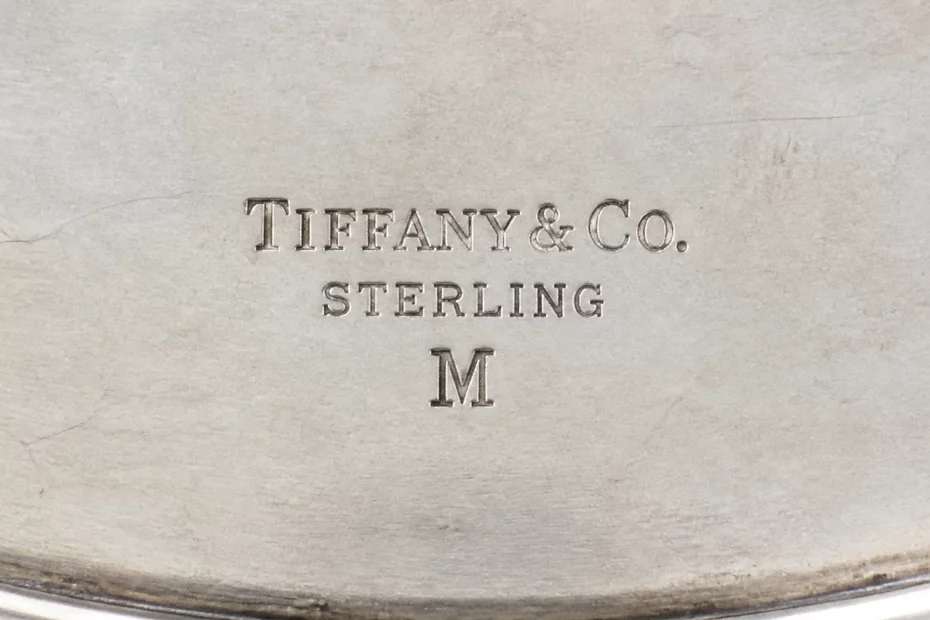
In the mid-to-late nineteenth century, particularly from 1851 to 1900, Tiffany pieces often featured a "T&Co" signature in a distinctive script. During this period, the company also utilized "directorship letters" to indicate the year of manufacture or the period under a specific head of the firm. For example, an Old English letter "M" indicates the tenure of Edward C. Moore (1870–1891), while a capital "T" denotes the era of Charles L. Tiffany (1891–1902).
By the early twentieth century, the signature evolved into the more recognizable "TIFFANY & CO." in block capitals. Authentic marks from this era are exceptionally crisp and deeply struck. If a mark appears shallow, unevenly spaced, or lacks the accompanying metal purity stamps (such as "750" for 18K gold or "PT950" for platinum), it is a major red flag for collectors. Tiffany also introduced a pattern number system for their hollowware and silver, which can be cross-referenced with historical records to confirm the exact year a design was first produced.
Cartier: The Majesty of the Serialized Script
Cartier’s approach to signing jewelry is characterized by a blend of French legal requirements and proprietary tracking. Because Cartier operated major workshops in Paris, London, and New York, the hallmarks found on their pre-1950 pieces vary by region.

A piece originating from the Paris workshop will almost always bear a French assay mark: the most famous being the eagle’s head for 18K gold and the dog’s head for platinum. These marks are tiny, often less than a millimeter in size, and are struck into the metal using a punch. Alongside these official marks, the "Cartier" signature itself is often found in a fine, hand-engraved script rather than a stamp.
Perhaps the most critical identification feature of vintage Cartier is the serial number. Unlike mass-produced items, Cartier’s high-end jewelry was traditionally numbered. Pre-1950 serial numbers are usually five or six digits and were recorded in the company’s archives. In modern vintage jewelry auctions, a piece that lacks a serial number or has a signature that looks "too perfect" (suggesting modern laser engraving rather than historical hand-tooling) requires careful scrutiny.
Georg Jensen: Scandinavian Precision and the Dotted Oval
Georg Jensen, the master silversmith of Denmark, revolutionized the world of jewelry in the early 1900s with his Art Nouveau and later Art Deco designs. His workshop utilized a series of marks that are highly prized for their clarity and aesthetic appeal.

The most iconic pre-1950 Georg Jensen mark is the "dotted oval." This feature consists of the name "GEORG JENSEN" enclosed in an oval border made of tiny raised dots. Within this oval, or adjacent to it, you will typically find the metal purity code "925 S" (denoting sterling silver) and the word "DENMARK."
Collectors should also look for designer initials. Jensen frequently collaborated with other artists, such as Henning Koppel or Johan Rohde, whose own marks appear alongside the Jensen signature. In the 1920s and 1930s, a crown motif was also occasionally used on certain high-end silver commissions. The absence of "Denmark" or a blurred, cast-in (rather than struck) hallmark is a common sign of a reproduction.
David-Andersen: Masters of Enamel and the Norwegian Mark
David-Andersen of Norway is renowned for exquisite enamel work and bold, Scandinavian modernist designs. Established in 1876, the firm’s early marks were often minimalist, reflecting the pragmatic nature of Norwegian craftsmanship.

For pieces produced before 1950, the signature "DAVID-ANDERSEN" or "D-A" was common, usually accompanied by "NORWAY STERLING" and the purity "925S." In very early pieces, you may encounter the mark "830S," which represents a slightly lower silver content that was standard in Norway during the late nineteenth century.
When examining David-Andersen pieces in vintage jewelry auctions, it is the quality of the enamel that often substantiates the mark. The signature was usually struck into the silver base before the glass enamel (guilloche) was applied. If the hallmark looks modern or sits "on top" of the enamel surface, it is likely not an authentic pre-1950 piece.
The Evolution of Signing Techniques: From Hand to Machine
One of the most fascinating aspects of identifying historic jewelry is observing how the signatures themselves were applied. In the early to mid-nineteenth century, signatures were frequently hand-engraved. This resulted in slight variations in line thickness and a "script" feel that is nearly impossible to replicate with modern tools.
As the Industrial Revolution progressed and jewelry production became more standardized, manufacturers moved toward steel punches. These punches allowed for identical "block capital" signatures that were deeper and more consistent. By the 1930s and 1940s, almost all major jewelry houses had shifted to these machine-engraved or die-struck marks. Understanding this transition helps a collector determine if a piece’s style matches the technology of its claimed era. For example, finding a perfectly uniform, deep block-capital mark on a ring claiming to be from 1840 is a chronological impossibility and a clear sign of a later reproduction or a genuine mistake in dating.
Practical Steps for Authentication
Authenticating signed jewelry is a process of verification. Start by using a 10x jeweler’s loupe to inspect every hidden surface of the piece: inside ring shanks, on the edge of brooch pins, and behind the jump rings of necklaces. If a mark is found, document its exact font, any enclosing borders (like ovals or shields), and its depth.
In the world of vintage jewelry auctions, provenance and documentation are your strongest allies. Comparing your findings against established hallmark databases and museum collections ensures that you are bidding with confidence and building a collection of true historical significance.
Understanding the history and origins of your collectibles is more than just a hobby; it is about preserving a legacy. Whether you are holding a nineteenth-century heirloom or a delicate piece of Georgian jewelry, knowing exactly what you have is the first step in being a true steward of history. Identifying antique jewelry requires looking beyond the sparkle to the hallmarks, maker's marks, and specific construction techniques of the era. It is the most reliable way to verify authenticity and ensure you are not just guessing about the age and value of your latest treasures.
If you are looking to add more history to your own collection, be sure to visit our ongoing auctions at Funky Junk Auctions. For those ready to dive deeper into their own research, you can explore our resources and visit us often to unlock the history of your finds. And for a truly comprehensive deep dive, don’t forget to check out our latest resource, Your Guide to Dating Antique and Vintage Collectibles, to sharpen your expert eye.
Team Funky
