The transition from the 19th to the 20th century marked one of the most profound shifts in the history of jewelry design. As the Victorian era drew to a close, two distinct yet contemporaneous movements emerged, each reflecting the changing social, artistic, and technological landscape of the time. For collectors participating in vintage jewelry auctions, understanding the nuances between Art Nouveau and Edwardian styles is essential. While both periods favored beauty and craftsmanship, they achieved their ends through vastly different philosophies and technical innovations.
The Organic Rebellion: Art Nouveau (c. 1890–1910)
Art Nouveau, meaning "New Art" in French, was a deliberate departure from the historicism and mass production of the Victorian era. It was a movement that prioritized artistic expression and manual skill over the intrinsic value of materials. Instead of focusing on large, expensive diamonds, Art Nouveau jewelers sought out semi-precious stones and organic materials that could better convey their vision of nature.

The hallmark of Art Nouveau jewelry is its fluid, asymmetrical, and organic forms. Influenced by the Japanese aesthetic and the Arts and Crafts movement, designers like René Lalique and Georges Fouquet drew inspiration from the natural world: but not the idealized nature of the past. Instead, they focused on the ephemeral and the eerie: insects, dragonflies, serpents, and the "femme fleur" (a mythological blending of woman and nature).
One of the most significant technical achievements of this period was the mastery of plique-à-jour enamel. This technique involves firing enamel into open cells with no backing, creating a translucent effect similar to a miniature stained-glass window. This allowed light to pass through the wings of a dragonfly or the petals of a flower, lending the jewelry an ethereal, otherworldly quality.
The Belle Époque Brilliance: Edwardian Elegance (c. 1901–1915)
While Art Nouveau was a rebellion, the Edwardian style: named for King Edward VII: was a celebration of the Belle Époque's luxury and high society. This was an era of formal garden parties, grand balls, and a return to neoclassical refinement. Unlike the dark, heavy mourning jewelry of the mid-Victorian period, Edwardian jewelry was designed to be light, airy, and "white."

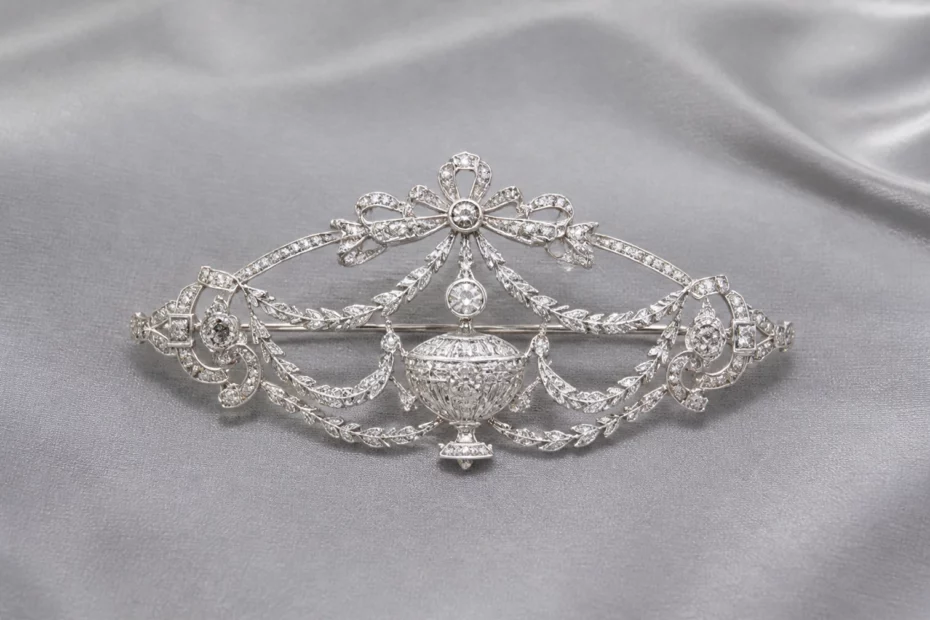
The Edwardian aesthetic is defined by the "Garland Style." Designers drew inspiration from 18th-century French court life, incorporating motifs like laurel wreaths, ribbons, tassels, and bow knots. These pieces were almost always symmetrical and utilized a monochromatic "white-on-white" palette, achieved through the use of platinum, diamonds, and pearls.
The shift toward this lighter aesthetic was not just a matter of taste; it was driven by a major technological breakthrough.
Technical Innovations: Platinum and the Oxyacetylene Torch
Before the turn of the century, jewelry that appeared to be made of white metal was often silver-topped gold. Silver was favored because it complemented diamonds better than yellow gold, but its softness meant it had to be used in thick layers and could tarnish over time. Platinum was known to be stronger and more durable, but it had a very high melting point that traditional jewelry torches could not reach.
In 1903, the invention of the oxyacetylene torch changed jewelry manufacturing forever. This tool provided a flame hot enough to melt and solder platinum with precision. For the first time, jewelers could create frames made entirely of platinum.

Because of platinum’s inherent strength and rigidity, designers could push the boundaries of metalwork. They created "knife-edge" settings: wires so thin they were nearly invisible to the eye: giving diamonds the appearance of floating on the wearer’s skin. This era also saw the rise of intricate filigree and milgrain work. Filigree involved threading fine, lace-like wires through the metal, while milgrain added a beaded texture to the edges of settings, further softening the "white" look of the piece.
Identifying the Shift in Vintage Jewelry Auctions
When browsing vintage jewelry auctions, collectors must look for specific technical cues to distinguish between these two overlapping styles.
Art Nouveau Identification Cues:
- Asymmetry: Look for "whiplash" curves and natural forms that do not mirror one another.
- Color Palette: Soft, muted tones are common. Look for enameling, opals, moonstones, and tourmalines.
- Metalwork: Primarily yellow gold or silver, often with a hand-hammered or "repoussé" (relief) texture.
- Motifs: Insects, flora, and the female form are predominant.

Edwardian Identification Cues:
- Symmetry: These pieces are balanced and orderly, reflecting neoclassical architecture.
- Color Palette: Dominantly white. Platinum, diamonds, and pearls are the primary components, with occasional colored gems used as accents.
- Metalwork: Fine platinum filigree and milgrain. The metal should look like lace or embroidery.
- Motifs: Bows, ribbons, garlands, and wreaths.
The End of an Era
The dawn of World War I in 1914 brought an abrupt end to the extravagance of the Edwardian era and the delicate artistry of Art Nouveau. Platinum was diverted for military use, and the social structures that supported such lavish adornment were forever altered. However, the innovations of this period: specifically the use of platinum and the refinement of filigree: laid the groundwork for the Art Deco movement that would follow in the 1920s.
For the modern enthusiast, pieces from the Art Nouveau and Edwardian periods represent a pinnacle of technical mastery. Whether it is the stained-glass beauty of a plique-à-jour dragonfly or the diamond-encrusted lace of a platinum brooch, these items remain some of the most sought-after finds in the world of antique collecting.
Understanding the history and origins of your collectibles is more than just a hobby; it is about preserving a legacy. Whether you are holding a nineteenth-century heirloom or a delicate piece of Georgian jewelry, knowing exactly what you have is the first step in being a true steward of history. Identifying antique jewelry requires looking beyond the sparkle to the hallmarks, maker's marks, and specific construction techniques of the era. It is the most reliable way to verify authenticity and ensure you are not just guessing about the age and value of your latest treasures.
If you are looking to add more history to your own collection, be sure to visit our ongoing auctions at Funky Junk Auctions. For those ready to dive deeper into their own research, you can explore our resources and visit us often to unlock the history of your finds. And for a truly comprehensive deep dive, don’t forget to check out our latest resource, Your Guide to Dating Antique and Vintage Collectibles, to sharpen your expert eye.
Team Funky
