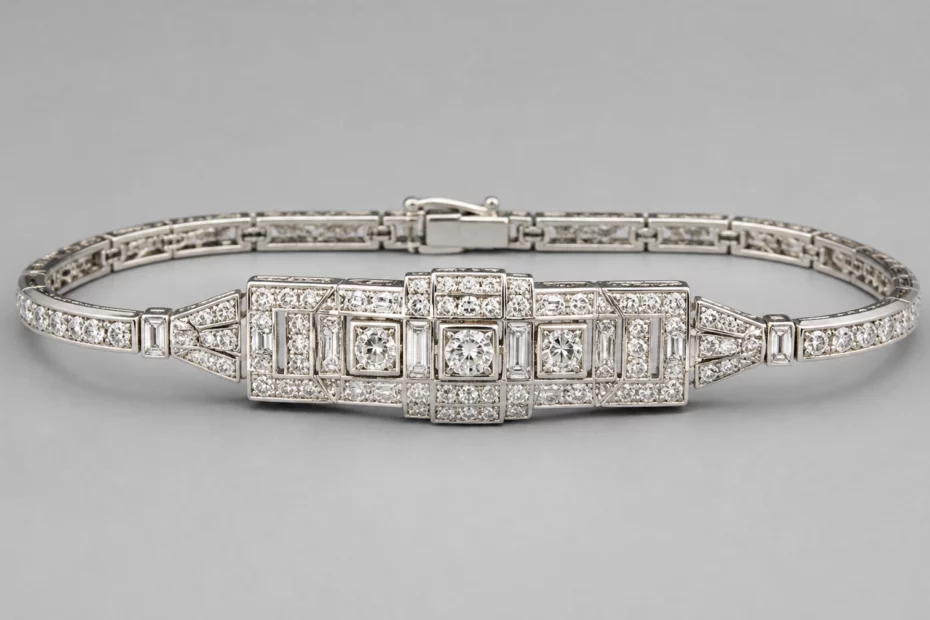
The evolution of jewelry design between 1920 and 1950 represents one of the most dramatic shifts in decorative arts history. This period, encompassing both the Art Deco and Retro eras, saw the transition from the ethereal, organic flowing lines of the early 20th century to a bold, structured aesthetic that celebrated the machine age and the resilience of wartime ingenuity. For those who frequent vintage jewelry auctions, understanding the nuances of these two distinct yet connected eras is essential for identifying high-quality craftsmanship and historical significance.
The Art Deco Movement: Precision and Progress (1920–1935)
The Art Deco movement formally emerged following the 1925 Exposition Internationale des Arts Décoratifs et Industriels Modernes in Paris. It was a stylistic response to a world rapidly modernizing after the First World War. Where previous generations favored the delicate curves of Art Nouveau, the Art Deco designer embraced the straight line, the circle, and the triangle. This era was defined by a rejection of the traditional and a full embrace of the "Machine Age."
Jewelry from this period is characterized by its meticulous symmetry and architectural motifs. The influence of cubism is evident in the flat planes and sharp angles used in bracelets, rings, and brooches. Jewelers began to view their work as "jewelry architecture," constructing pieces that mirrored the soaring skyscrapers and monumental buildings of the time. This was the era of the skyscraper ring and the stepped-pinnacle brooch, designs that felt as solid and intentional as a city skyline.
Materials and the "White Period"
During the height of Art Deco, platinum was the metal of choice. Its strength allowed for incredibly fine, almost invisible settings that maximized the brilliance of diamonds. This led to what historians call the "white period" of the early 1930s, where the combination of platinum (or white gold) and clear diamonds created a monochromatic, icy elegance.
However, contrast was equally important. To break the uniformity of white metals, designers utilized high-contrast materials such as black onyx, coral, and lapis lazuli. The juxtaposition of a jet-black onyx plaque against a field of white diamonds remains one of the most iconic signatures of the Art Deco aesthetic.


The Transition to the Retro Era (1935–1950)
As the 1930s progressed, the sharp geometry of Art Deco began to soften. The global impact of the Great Depression followed by the onset of World War II necessitated a shift in both materials and design philosophy. By 1935, the jewelry world had entered the "Retro" or "Retro Modern" era, a style that would dominate until the end of the 1940s.
The most significant driver of this change was the scarcity of materials. Platinum, a critical resource for military and industrial applications, was banned for jewelry use in many countries during the war. This forced jewelers to return to gold, but with a new twist. To achieve a modern look, they experimented with alloys, leading to the immense popularity of yellow and rose (pink) gold. Often, these two tones were used together in a single piece to create depth and visual interest.
Voluminous Sculptural Design
Unlike the flat, two-dimensional planes of Art Deco, Retro jewelry was voluminous, three-dimensional, and highly sculptural. Designs moved away from rigid rectangles and toward fluid scrolls, ribbons, and fans. Despite this newfound fluidity, the influence of the machine age remained. Retro jewelry often appeared "heavy" and substantial, reflecting a sense of power and resilience during uncertain times.
This was the era of the Hollywood glamour piece. With fabric being rationed for clothing, jewelry became the primary way for women to express style. Large cocktail rings with massive center stones: such as citrine, amethyst, and aquamarine: became essential accessories. These "statement" pieces were designed to be seen from a distance, whether on a cinema screen or at a gala.

The Bridge Between Eras: The Tank Bracelet
One of the most fascinating examples of the overlap between late Art Deco and the Retro era is the "tank" bracelet. The name itself is a direct nod to the industrial landscape of the period, derived from the resemblance of the bracelet's links to the treads, or caterpillars, of a military tank.
In the late 1930s, these bracelets were often executed in the cooling white tones of Art Deco, featuring articulated geometric links set with small diamonds. However, as the Retro era took hold, the tank bracelet evolved into a bold, chunky gold staple. The links became more rounded, the gold grew more substantial, and the overall look shifted from delicate precision to mechanical strength.
The tank bracelet remains a favorite in our vintage jewelry auctions because it perfectly encapsulates the transition of the early 20th century: it is both a piece of fine art and a celebration of industrial design.


Legacy and Identification
For collectors and enthusiasts, identifying pieces from these eras requires an eye for detail and an understanding of the historical context. Look for the sharp, symmetrical lines and platinum settings of the 1920s to identify Art Deco. Conversely, look for the warm tones of yellow and rose gold, the sculptural "ribbon" motifs, and the substantial weight of the 1940s to identify Retro pieces.
Whether you are looking for the precise "jewelry architecture" of the Jazz Age or the bold, resilient glamour of the wartime years, both eras offer a wealth of unique finds. We invite you to explore our upcoming collections, which frequently feature jewelry, vintage cards, antiques, and much more….
Team Funky
Understanding the history and origins of your collectibles is more than just a hobby; it is about preserving a legacy. Whether you are holding a nineteenth-century heirloom or a delicate piece of Georgian jewelry, knowing exactly what you have is the first step in being a true steward of history. Identifying antique jewelry requires looking beyond the sparkle to the hallmarks, maker's marks, and specific construction techniques of the era. It is the most reliable way to verify authenticity and ensure you are not just guessing about the age and value of your latest treasures.
If you are looking to add more history to your own collection, be sure to visit our ongoing auctions at Funky Junk Auctions. For those ready to dive deeper into their own research, you can explore our resources and visit us often to unlock the history of your finds. And for a truly comprehensive deep dive, don’t forget to check out our latest resource, Your Guide to Dating Antique and Vintage Collectibles, to sharpen your expert eye.
Team Funky
