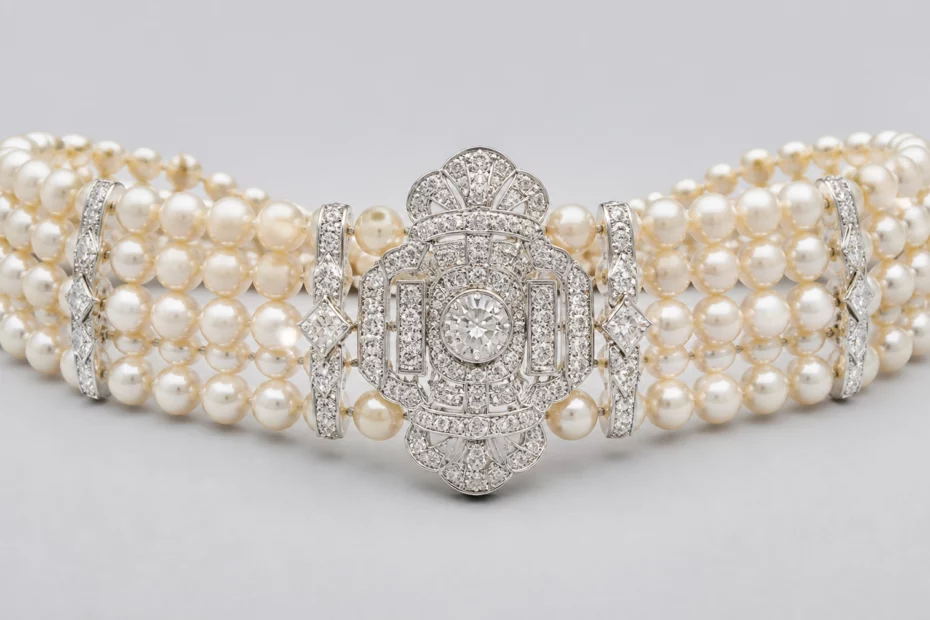
The history of jewelry is, in many ways, the history of monarchy. For centuries, the royal courts of Europe were not merely centers of political power, but the primary engines of style, luxury, and technical innovation. The pieces commissioned by kings and queens served as the ultimate benchmarks for craftsmanship, often dictating the materials, motifs, and silhouettes that would define entire eras. For the modern collector exploring vintage jewelry auctions, understanding these royal lineages provides a crucial framework for dating and valuing fine antique pieces.
From the opulent "white-on-white" elegance of the Belle Époque to the innovative use of color and enamel in the Russian Imperial court, royal collections have shaped the global jewelry market in profound ways. This influence was often amplified by significant historical shifts: such as the dispersal of the French Crown Jewels and the post-revolution sale of Romanov treasures: which allowed royal styles and stones to migrate into the private market, forever altering the landscape of high jewelry.
Queen Alexandra and the Belle Époque Aesthetic
If Queen Victoria defined the sentimental and mourning jewelry of the 19th century, it was her daughter-in-law, Queen Alexandra, who orchestrated the transition into the luminous, ethereal style of the early 20th century. As the Princess of Wales and later Queen Consort to Edward VII, Alexandra was a global fashion icon whose personal preferences directly birthed what we now recognize as the Belle Époque and Edwardian styles.
The most enduring of Alexandra’s contributions was the popularization of the collier de chien, or "dog-collar" choker. Legend suggests she wore these high, multi-strand necklaces of pearls and diamonds to conceal a small scar on her neck, but the aesthetic result was a worldwide obsession. These chokers, often featuring delicate platinum spacers and ornate central buckles, required the highest level of smithing. The transition from heavy Victorian yellow gold to the "white-on-white" palette: utilizing diamonds, pearls, and the newly refined strength of platinum: allowed for lace-like, airy designs that seemed to float against the skin. This period's emphasis on garlands, bows, and tassels continues to be a highlight of high-end vintage jewelry auctions today.

The Dispersal of the French Crown Jewels
While the British royal family maintained and evolved its collection, the French Crown Jewels met a more dramatic fate that significantly impacted the international jewelry trade. In 1887, the French Third Republic made the controversial decision to auction off a vast majority of the crown jewels, fearing that the regalia might serve as a rallying point for royalist restoration.
This event was a watershed moment for the jewelry world. Leading houses, most notably Tiffany & Co., purchased significant portions of the collection. Charles Tiffany’s acquisition of approximately one-third of the French crown jewels not only earned him the nickname "The King of Diamonds" but also brought the prestige of European royalty to the Gilded Age elite in America. Industrialist families like the Vanderbilts and Astors began commissioning pieces that mirrored the scale and grandeur of the French regalia. This dispersal "democratized" royal-level luxury for the ultra-wealthy outside of the traditional aristocracy, cementing the status of the "grand parure" (a matching set of necklace, earrings, brooch, and tiara) as the pinnacle of social standing.


The Russian Connection: Fabergé and the Kokoshnik
The Russian Imperial court under the Romanovs was arguably the most extravagant in Europe. Before the 1917 Revolution, St. Petersburg was a hub of jewelry innovation where the quality of work often surpassed that of the leading Parisian houses. The influence of Russian style was most visible in the "kokoshnik" tiara: a broad, halo-shaped headpiece inspired by traditional Russian folk dress. When the Russian style was adopted by the British and other European courts, it became a standard form for high-society tiaras, characterized by a wall of brilliant-cut diamonds set in platinum or white gold.
Furthermore, the work of Peter Carl Fabergé revolutionized the use of color and texture. Fabergé’s mastery of guilloché enamel: a technique where translucent enamel is applied over precisely engraved patterns in metal: set a benchmark for luxury objects and jewelry that influenced contemporaries like Cartier. Following the Russian Revolution, the Bolshevik government’s subsequent sale of Romanov treasures in the 1920s and 30s flooded Western markets with high-quality emeralds, sapphires, and diamonds, many of which were later re-set into the Art Deco styles of the era.

The British Crown Jewels: A Living Archive
Unlike the dispersed French and Russian collections, the British Crown Jewels and the broader Royal Collection remain a living, evolving archive. The influence here is largely one of continuity and adaptation. The official Crown Jeweller, a position held by Garrard for over 160 years, was responsible for creating some of the most iconic pieces of the 19th and 20th centuries.
A key figure in the evolution of this collection was Queen Mary, who was known for her "jewelry-obsessed" nature and her penchant for remodeling older pieces to suit contemporary tastes. She popularized the concept of "convertible" jewelry: tiaras that could be dismantled into necklaces or brooches, and stomachers that could be divided into smaller clips. This versatility is a hallmark of the finest early 20th-century jewelry and is a feature highly sought after in vintage jewelry auctions. The British royal family’s consistent visibility on the world stage ensures that their aesthetic choices: such as the late Princess Diana’s sapphire halo engagement ring: continue to drive consumer demand for specific vintage-style settings decades later.

Conclusion: The Legacy of Royal Influence
The influence of royal collections on jewelry history cannot be overstated. Whether through the direct setting of trends by figures like Queen Alexandra or through the historical upheaval that brought crown jewels into the public sphere, the standards of the court became the standards of the industry. For collectors today, these pieces represent more than just precious materials; they are artifacts of a time when jewelry was the ultimate language of diplomacy, power, and artistic achievement.
When you participate in vintage jewelry auctions, you are often bidding on the echoes of these royal traditions. The precision of a platinum setting, the depth of a royal blue enamel, or the classic silhouette of a pearl choker all trace their lineage back to the master jewelers who served the crowns of Europe.
Understanding the history and origins of your collectibles is more than just a hobby; it is about preserving a legacy. Whether you are holding a nineteenth-century heirloom or a delicate piece of Georgian jewelry, knowing exactly what you have is the first step in being a true steward of history. Identifying antique jewelry requires looking beyond the sparkle to the hallmarks, maker's marks, and specific construction techniques of the era. It is the most reliable way to verify authenticity and ensure you are not just guessing about the age and value of your latest treasures.
If you are looking to add more history to your own collection, be sure to visit our ongoing auctions at Funky Junk Auctions. For those ready to dive deeper into their own research, you can explore our resources and visit us often to unlock the history of your finds. And for a truly comprehensive deep dive, don’t forget to check out our latest resource, Your Guide to Dating Antique and Vintage Collectibles, to sharpen your expert eye.
Team Funky
