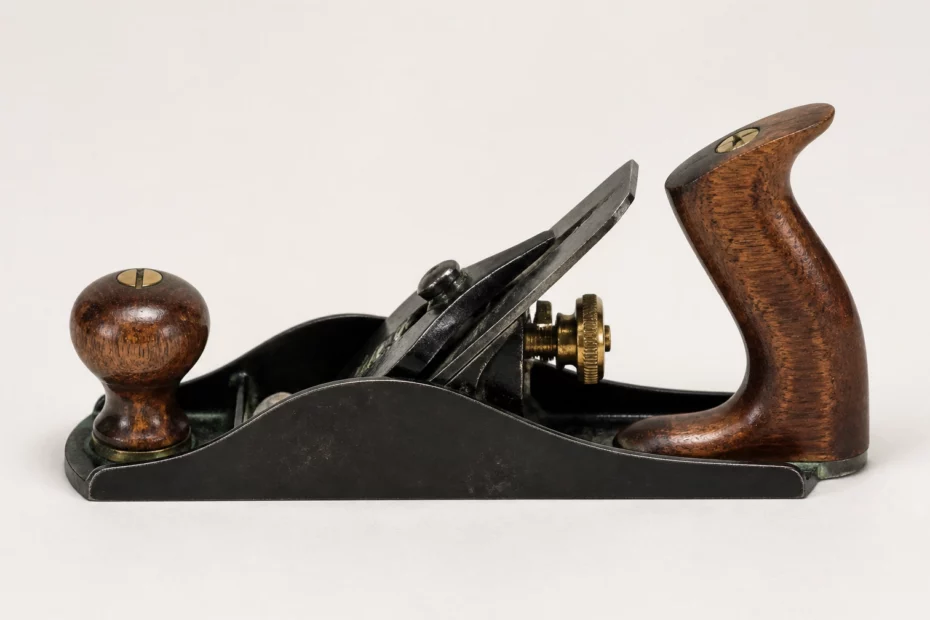
Welcome back to our deep dive into the world of Stanley tools…. we are so glad you're here for the second installment of our series! If you missed Part 1, we kicked things off with the history of the Stanley Rule & Level Co. and how they came to dominate the woodworking world. Today, we’re getting into the nitty-gritty of Stanley Bailey planes and that famous "Type Study" everyone talks about at antique tool auctions.
When you’re out hunting for treasures, you might hear collectors throw around terms like "Type 4" or "Type 11." It sounds like a secret code…. and in a way, it is! A Type Study is an unofficial classification system developed by historians like Roger Smith to help us date these tools based on tiny design changes. Stanley didn't keep these records themselves; collectors did the hard work of documenting every frog adjustment, handle material, and patent date to create a timeline of evolution. Understanding these types is the key to knowing if you've found a common worker or a museum-grade rarity.
The Holy Grail: The Stanley No. 1
We have to start with the big one…. well, actually, the smallest one! The Stanley No. 1 is the undisputed holy grail for many collectors. Measuring just 5½ inches long with a tiny 1¼-inch iron, it’s a diminutive smoothing plane that packs a massive punch in value. Because they were produced in much smaller quantities than the standard No. 4 or No. 5, finding an authentic one in good condition is a major win.

The No. 1 is unique because it never quite followed the same rules as its bigger brothers. It never received a lateral adjustment lever, and it didn't get the frog adjustment screw that appeared on larger planes around 1910. Fun fact…. these were famously used by beekeepers to adjust hive boxes in the field and by fly-rod makers for precision work on bamboo. If you spot one at an auction, expect the bidding to get lively!
The Swiss Army Knife: The Stanley No. 55
If the No. 1 is about simplicity and size, the Stanley No. 55 is all about complexity. Often called "The Planing Mill," this beast was designed to do the work of an entire shelf of molding planes. It’s a combination plane that came with over 50 different cutters, allowing a woodworker to create beads, hollows, rounds, and complex ogee profiles with just one tool.

Collectors love the No. 55 for its mechanical beauty. It’s a maze of fences, sliding sections, and depth stops. When we find these at our antique tool auctions, we always check to see if the original wooden boxes and the full set of cutters are still present. A complete No. 55 is a sight to behold and a testament to the engineering genius of the late 19th century.
The Finishing Specialist: The Stanley No. 87
Then we have the Stanley No. 87, a tool built for a very specific job. This isn't your average smoothing plane; it’s a cabinet scraper plane. Unlike a regular plane that slices the wood at an angle, the No. 87 holds its blade nearly vertically to scrape the surface. This is the tool you reach for when you're working with "difficult" woods like curly maple or bird’s-eye maple that are prone to tearing.

The No. 87 provides the control of a plane sole with the delicate action of a hand scraper. It’s a heavy-duty finisher that helps achieve that glass-smooth surface on high-end furniture. For the serious restorer, having one of these in the kit is a game-changer for those stubborn wood grains.
Whether you're looking for a tiny No. 1, a complex No. 55, or a specialized No. 87, keeping an eye on the details is what makes collecting so much fun. We are always adding awesome vintage tools, unique finds, and rare collectibles to our catalogs…. you never know what you'll find next!
Understanding the history and origins of your collectibles is more than just a hobby; it is about preserving a legacy. Whether you are holding a nineteenth-century hand plane or a delicate piece of Georgian jewelry, knowing exactly what you have is the first step in being a true steward of history. A patent chart is an essential research tool for collectors, and by matching the patent numbers stamped on your items to these specific charts, you can pinpoint the exact year and manufacturing 'type' of your find. It is one of the most reliable ways to verify authenticity and make informed decisions about age, rarity, and value.
If you are looking to add more history to your own collection, be sure to visit our ongoing auctions at Funky Junk Auctions. For those ready to dive deeper into their own research, you can bookmark our permanent patent charts page and visit us often to unlock the history of your finds. And for a truly comprehensive deep dive, don’t forget to check out our latest resource, Your Guide to Dating Antique and Vintage Collectibles, to sharpen your expert eye.
Team Funky
