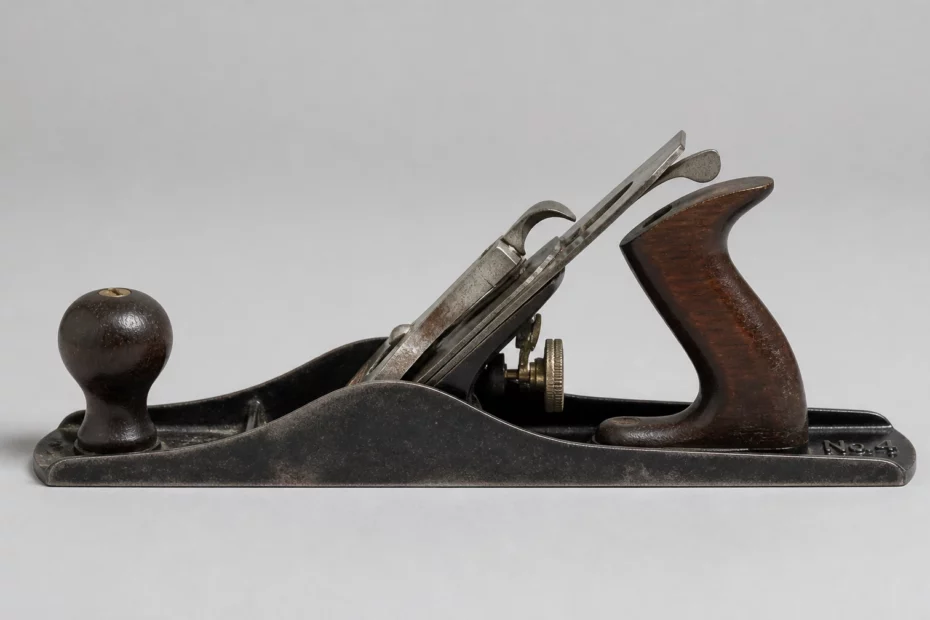
Stanley hand plane model numbers provide an essential framework for identifying, classifying, and evaluating some of the most widely collected woodworking tools in North America. For collectors, woodworkers, and auction buyers alike, understanding these numbers is often the first step in distinguishing between common production models and more desirable or specialized examples.
Although Stanley’s numbering system can appear inconsistent at first glance, much of it follows a practical internal logic. Examining the numbering conventions used across bench planes, fractional models, premium Bed Rock planes, and specialty tools offers a clearer understanding of how these tools were organized and marketed over time.
The Foundation: The No. 1 to No. 8 Bench Planes
For the core group of iron bench planes, Stanley kept things simple. They adopted Leonard Bailey’s original scheme where the numbers 1 through 8 represent the size of the plane. Generally speaking, the higher the number, the longer and heavier the tool.

- No. 1 & No. 2: These are small smoothing planes. They are highly sought after by collectors in part because they were produced in comparatively limited quantities.
- No. 3 & No. 4: These are standard smoothing planes, commonly used for final surface preparation and finish work.
- No. 5: Known as the "Jack Plane," this model is widely regarded as one of the most versatile general-purpose bench planes.
- No. 6: Often called the "Fore Plane," it is typically associated with the initial leveling and truing of longer boards.
- No. 7 & No. 8: These are jointer planes, designed to straighten edges and flatten long surfaces with a high degree of accuracy.
The "In-Betweeners": Fractional Numbers
Fractional numbers such as No. 4-1/2 or No. 5-1/4 represent purposeful variations within the standard lineup rather than errors in designation. Stanley introduced these intermediate sizes to address specific use cases. The 4-1/2 is essentially a wider and heavier version of the No. 4 smoothing plane, while the 5-1/4, often referred to as the "Junior Jack," was commonly used in educational settings because of its more manageable size.
The Premium League: The 600 Series Bed Rocks
Three-digit numbers beginning with 6, such as 604 or 605, identify planes in the Bed Rock line. These represented Stanley’s premium bench plane offering. The numbering convention is straightforward: the prefix "60" is added to the corresponding standard Bailey number. Accordingly, a 604 is the premium counterpart to a No. 4, while a 607 corresponds to a No. 7 jointer. These models are especially valued for their refined frog-to-bed design, which improves stability and adjustability.

Getting Specialized: The Wild World of 45, 55, and 71
Beyond the standard bench plane range, Stanley’s numbering system becomes less about size and more about the specific pattern or function of the tool. This shift is particularly important in the identification of specialty planes.

The No. 45 is a well-known combination plane capable of performing the work of multiple dedicated molding and joinery planes. The No. 55 expanded this concept further and was often marketed as a "Universal Combination Plane" because of its broad range of cutting capabilities.
The No. 71 is a router plane, a distinctly different form used for refining the bottoms of grooves, dados, and recesses. In cases such as these, the assigned numbers function primarily as catalog designations rather than direct indicators of size.

Where to Look for the Number
On most Stanley planes, the model number is cast directly into the iron body. On larger bench planes, typically No. 5 and above, the number is often found at the heel, or rear, of the plane. On smaller examples, it is frequently located at the toe, or front. If no number is present, the tool may be from an earlier production period or from another manufacturer, requiring identification through additional physical and historical characteristics.
These tools remain important artifacts of woodworking history, and careful identification helps place each example within its proper manufacturing and collecting context.
Understanding the history and origins of your collectibles is more than just a hobby; it is about preserving a legacy. Whether you are holding a nineteenth-century hand plane or a delicate piece of Georgian jewelry, knowing exactly what you have is the first step in being a true steward of history. A patent chart is essentially a roadmap for collectors, and by matching the patent numbers stamped on your items to these specific charts, you can pinpoint the exact year and manufacturing 'type' of your find. It is the most reliable way to verify authenticity and ensure you are not just guessing about the age and value of your latest treasures.
If you are looking to add more history to your own collection, be sure to visit our ongoing auctions at Funky Junk Auctions. For those ready to dive deeper into their own research, you can bookmark our permanent patent charts page and visit us often to unlock the history of your finds. And for a truly comprehensive deep dive, don’t forget to check out our latest resource, Your Guide to Dating Antique and Vintage Collectibles, to sharpen your expert eye.
Team Funky
