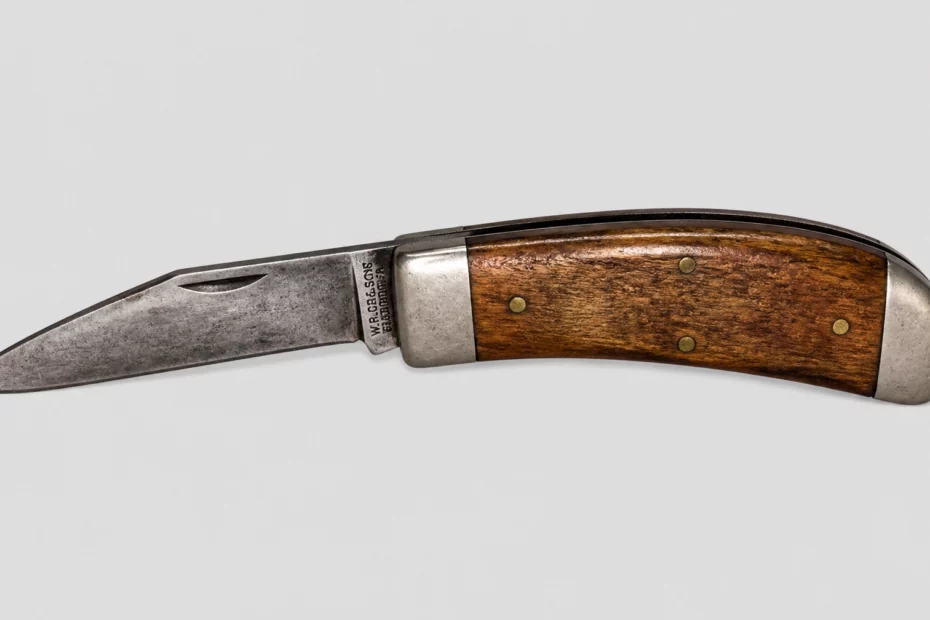
Hey there, neighbors! We are so excited to kick off a brand new series here at Funky Junk Auctions…. we know how much you all love those little bits of history you can carry right in your pocket! Whether you call them pocket knives, jackknives, or just your "trusty blade," these tools have a story that goes back way further than your grandpa’s old fishing knife.
When we're setting up for our online collectible auctions, we see some truly AWESOME VINTAGE TOOLS come through the door. It got us thinking…. where did the idea of a folding knife actually start? Who decided that a knife was great, but a knife that folds in half was even better? Well, grab a coffee and settle in, because we're taking a trip back through time to find out!
It All Started in the Iron Age…. The Hallstatt Culture
Believe it or not, people were carrying folding knives long before the Romans were building roads or the Vikings were sailing the seas. The earliest "pocket knife" we know of comes from the Hallstatt culture in what is now modern-day Austria.

Around 600 to 500 BCE: that's over 2,500 years ago!: someone was buried with a very special treat: a folding knife with a bone handle. Now, this wasn't like the fancy multi-tools we see today. It was a simple "friction folder." There were no springs to snap it shut or locks to keep it open. You just pulled the blade out, and the friction of the handle against the blade held it in place while you worked.
Because it was found in a rich burial site and had a beautifully carved bone handle, archaeologists think it was a high-status item. Even back then, a cool folding knife was a total flex! It’s the kind of item that would be the "star of the show" at any of our antique auctions today.
The Romans and the World's First Multi-Tool
Fast forward a few hundred years, and the Romans really took the idea of the folding knife and ran with it. While we usually think of Romans with big swords and shields, they were actually big fans of "everyday carry" items too.

By the 1st and 2nd centuries CE, pocket knives were everywhere in the Roman Empire. They made them out of bronze, iron, and even silver for the wealthy folks. But the coolest part? They invented the very first MULTI-TOOL.
We've seen photos of Roman artifacts that include a knife blade, a spoon, a little spike (maybe for getting snails out of shells: yummy?), and even a toothpick! All of these folded into one single handle. Can you imagine finding one of those in a box of old goodies? It just goes to show that people have always loved gadgets that do it all. Most Roman knives were still friction folders, often featuring a long tang that you’d hold down with your thumb to keep the blade from closing on your fingers while you worked. Smart, right?
The "Peasant Knife" – Simple, Reliable, and Cheap
As we moved into the Middle Ages and the early modern period, the folding knife became a staple for the "everyman." These weren't the fancy silver multi-tools of the Roman elite…. they were rugged, simple, and meant for hard work.

In many parts of Europe, these were known as "Peasant Knives" or "Penny Knives" because they were so inexpensive to buy. Imagine a simple piece of wood or horn for a handle, a single pivot pin, and a steel blade. That’s it! No bells, no whistles, just a tool that got the job done.
These were the ultimate "fun stuff" for farmers, shepherds, and tradespeople. You could use it to cut rope, whittle a stick, or slice a piece of cheese for lunch. Because they were so simple, they were easy to fix if they broke. We see the descendants of these simple friction folders all the time in our vintage tool collections, and there is just something so honest and cool about a tool that hasn't changed its basic design in centuries!
The 17th Century Revolution: The Slipjoint
Everything changed in the 1600s, and we have the master cutlers of Sheffield, England, to thank for it. Before this, you either had a friction folder or a fixed blade. But then, some absolute genius invented the SLIPJOINT mechanism.

The slipjoint added a "backspring" to the knife. This is a piece of metal along the spine of the handle that puts pressure on the back of the blade. When you open the knife, you feel that satisfying "snap" as the blade locks into place (though not a "true" lock, it stays open much better than a friction folder).
This invention was a GAME CHANGER. It made pocket knives much safer and easier to use with one hand. This is the same technology used in the famous BARLOW KNIFE, which started appearing around this time. The slipjoint is the "grandaddy" of almost every traditional pocket knife you see today, from the classic Swiss Army knife to the old-timer folders we love to find at auctions.
Why We Love These Vintage Goodies
When you hold an old pocket knife, you’re holding a piece of human history. From a bone-handled folder in a Celtic tomb to a silver Roman multi-tool, these items were built to be useful, portable, and personal. They weren't just tools; they were companions!
We are always on the lookout for VINTAGE POCKET KNIVES and OTHER COOL COLLECTIBLES to bring to you. Our online collectible auctions are full of surprises…. you never know when a piece of history like this might pop up!
Keep an eye out for Part 2 of our series, where we’ll be talking about the different types of blades and handles that make these knives so unique. Until then, stay funky!
And don't forget, if you win a treasure in one of our auctions, we make it super easy with our scheduled curbside pickup right here at our warehouse. No fuss, just fun stuff!
Team Funky
